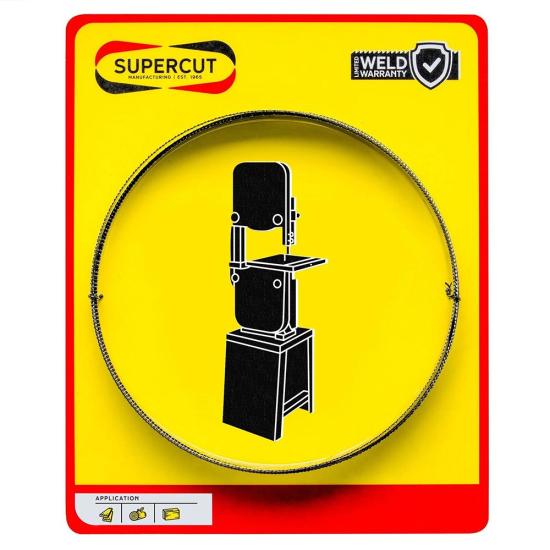
SuperCut Woodsaver Carbide Thin-Kerf Bandsaw Resaw Blades
SuperCut Woodsaver Carbide Resaw blades are precision-ground, thin-kerf resaw blades engineered to maximize yield when cutting expensive hardwoods. By removing less material, these blades produce less waste, require less horsepower, and allow lower feed pressure for smoother, more controlled cuts. The reduced kerf also generates less heat, helping the blade run cooler and significantly extending blade life.
SuperCut Woodsaver Carbide bandsaw blades feature precision-ground, razor-sharp teeth, a rounded blade back, polished sides, and an aggressive hook tooth grind with an optimized tooth set for fast, efficient cutting. Most importantly, the teeth undergo SuperCut’s industry-leading carbide impregnation process. Instead of attaching a solid carbide tip to each tooth, microscopic carbide particles are embedded into the cutting edge using a proprietary high-energy bonding process. These carbide particles then become part of the cutting structure delivering exceptional wear resistance and dramatically longer cutting life.
All these features result in a blade that tracks smoother, cuts cleaner, and lasts significantly longer than comparable bandsaw blades. The aggressive hook tooth geometry ensures rapid cutting with efficient chip removal, making these blades ideal for demanding woodworking applications, such as resawing.
Available in 5/8” width with amultiple widths and tooth patterns to suit a wide range of resawing and general woodworking needs.
All welds are backed by SuperCut’s Limited Lifetime Weld Warranty against premature breakage.
Proudly 100% made in the USA, these high-performance bandsaw blades are engineered for precision cutting in softwoods, hardwoods, and wood composites—built for woodworkers who demand the best.
Recommended TPI (Teeth Per Inch)
Selecting the correct TPI depends on the thickness (cross-section) of the material being cut. For best performance, keep 2 to 10 teeth engaged in the cut at all times.
General rule:- Thicker materials = fewer TPI
- Thinner materials = more TPI
Blade Width vs. Minimum Cutting Radius (Rule of Thumb)
Blade Width Minimum Radius1/4" 5/8"
3/8" 1-1/2"
1/2" 2-1/2"
5/8" 4"
3/4" 5-1/2"
Tooth Style Guide
Under 10 TPI — Hook Tooth (Positive Rake)
Blades with fewer than 10 TPI feature a hook tooth design, with a forward hook angle (positive rake), deep gullets, and widely spaced teeth. This design delivers fast cutting, excellent chip removal, and aggressive performance.
Best for:- Thick hardwoods
- Resawing
- Green wood
- General shop cutting when speed matters more than finish quality
10 TPI and Higher — Raker Tooth (Neutral Rake)
Blades with 10 TPI and higher typically feature a raker tooth design, with a neutral rake angle and shallower gullets. Cutting is slower and more controlled, producing a smoother finish with less tear-out.
Best for:- General everyday cutting
- Thinner materials
- Projects where a cleaner cut is preferred
Note: Always Detension Your Blade
When you’re finished cutting for the day, release the tension on your bandsaw blade.
Bandsaw blades heat up during use and expand slightly. As they cool, they shrink by several thousandths of an inch. If the blade is left under tension while cooling, it can effectively over-tension itself. Over time, the blade can begin to “remember” the shape of the wheels, which may lead to vibration, fatigue, and cracking—especially in the gullets.
Leaving a blade tensioned on the saw can also:
- Distort the crown and flatten tires, making them harder and less effective
- Place unnecessary stress on bearings and shafts
- Gradually affect wheel alignment/geometry and shorten bearing life
- Continue compressing tires or V-belts, reducing their lifespan
Detensioning your blade is a simple habit that helps protect your saw and extends the life of both the blade and key components.