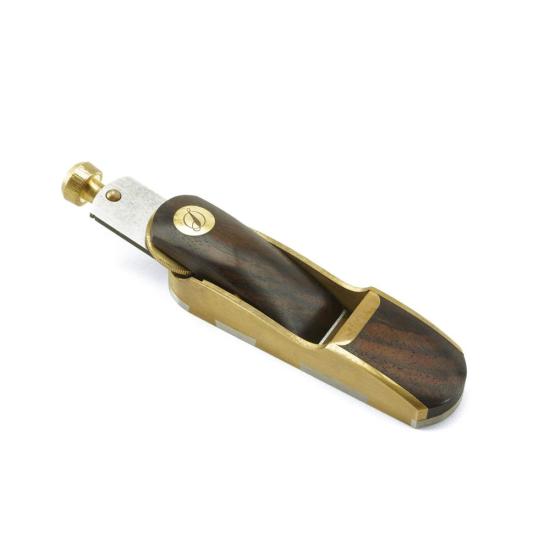
The Ironbark Infill Block Plane is designed with a deep appreciation for historic block planes, combined with modern materials and manufacturing techniques to create a traditionally-styled tool with state-of-the-art performance.
The sole of the plane is machined from a single piece of stainless steel, the sides as solid brass double dovetailed into the sole. The blade is bedded at 12 degrees and is controlled by both a depth adjuster and a lateral adjuster. Mouth control is achieved through a removable brass insert, allowing the opening to be tuned or modified as required.
Despite its compact size, many users are surprised by the plane’s substantial weight—especially when compared to larger Stanley block planes. Weight is a critical factor in small planes: too light and the tool becomes difficult to control and lacks feedback; too heavy and it becomes fatiguing. While excess weight is a disadvantage in larger planes, achieving sufficient mass in a small block plane is essential for stability and smooth cutting. The Ironbark strikes this balance exceptionally well.
Several design elements set this plane apart from any other low-angle infill plane. Most notably, the sole and sides are machined from a single piece of stainless steel rather than assembled from separate components joined near the mouth. This results in a far more stable tool and is a feat that requires a combination of handwork and advanced modern machining techniques. Additionally, the wedge-style lever cap is retained by precision-machined slots in the plane body—a construction method that would not have been possible during the 17th to 19th centuries when traditional infill planes were first made. This design allows for a lower overall profile and a more comfortable grip in use.
The 12-degree bedding angle makes the plane ideal for end-grain work. As a bevel-up plane, the effective cutting angle can be varied by altering the sharpening angle of the blade, allowing the tool to perform equally well on highly figured or difficult grain. The single-piece stainless steel body, combined with the dense Rosewood infill, results in an exceptionally robust plane compared to cast or molded designs. The thick steel sole, rigid sides, and dense wood infill also contribute to the plane’s mass, allowing it to glide smoothly through surface imperfections with ease.
When combined with a blade sharpened to 25–30 degrees, the low 12-degree bed results in an effective cutting angle of less than 45 degrees. The blade is manufactured from 18% tungsten M2 high-speed steel, making it especially resistant to wear when working abrasive or dense hardwoods common in Australia. High-speed steel also retains its edge longer and can be ground or sharpened on powered equipment with less risk of damaging the temper. While it is often assumed that high-speed steel cannot take as keen an edge as carbon steel, edge quality is largely dependent on heat treatment. In this case, the steel and heat treatment have been specifically optimized for woodworking performance.